
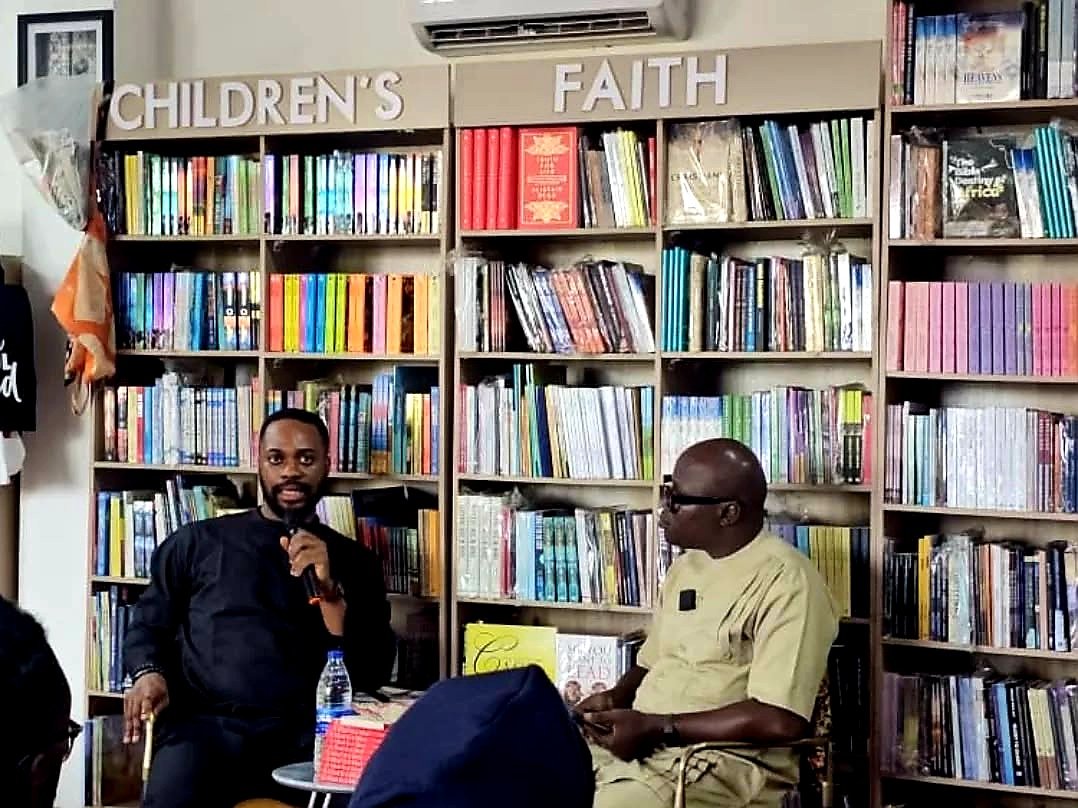
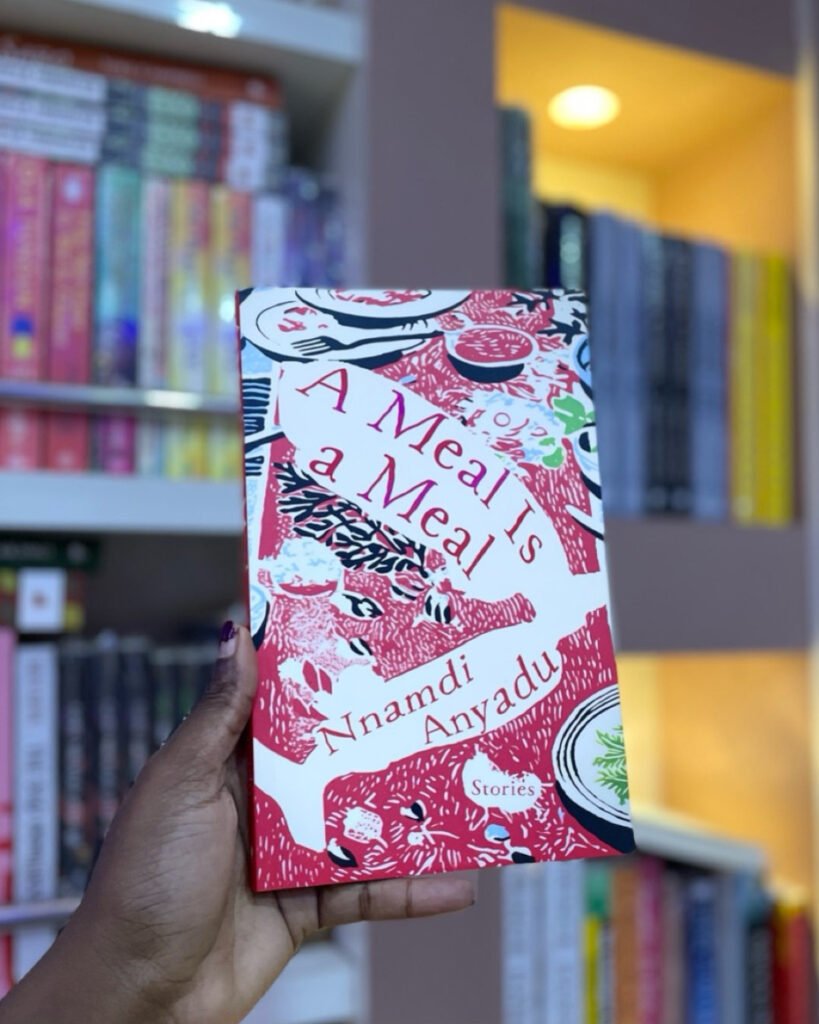
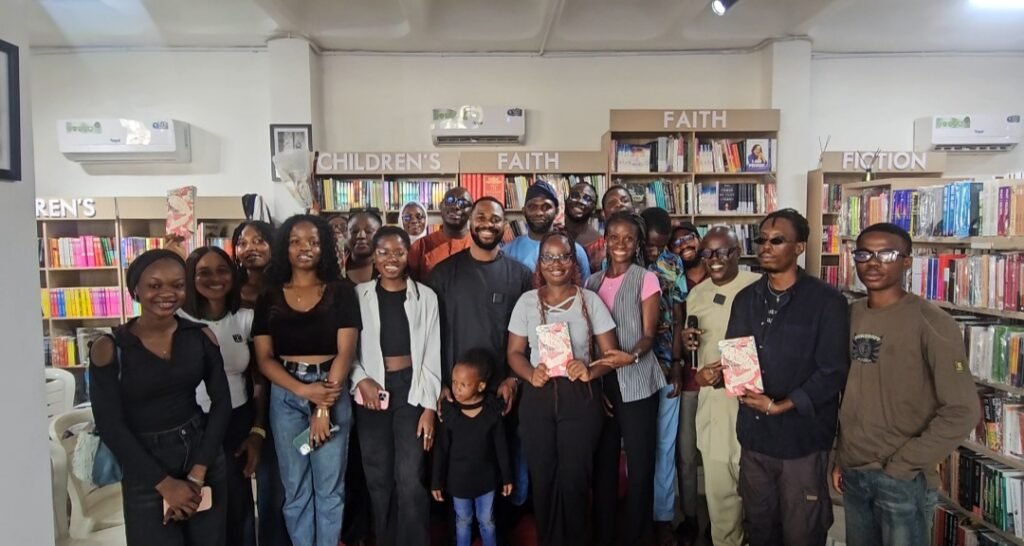
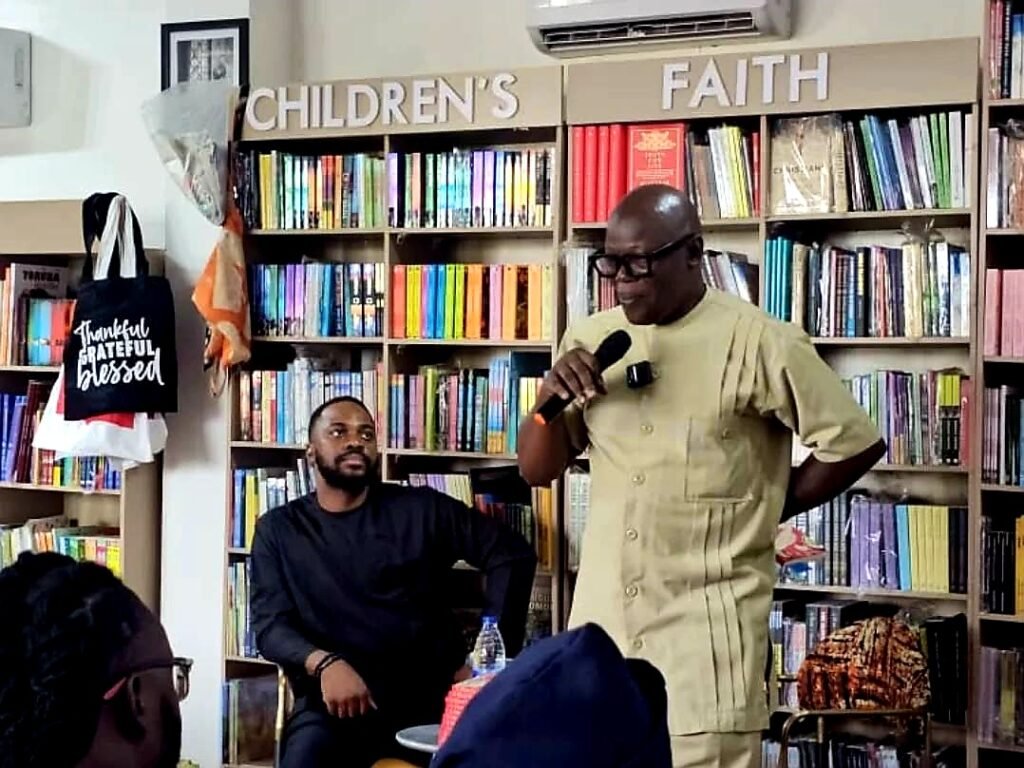
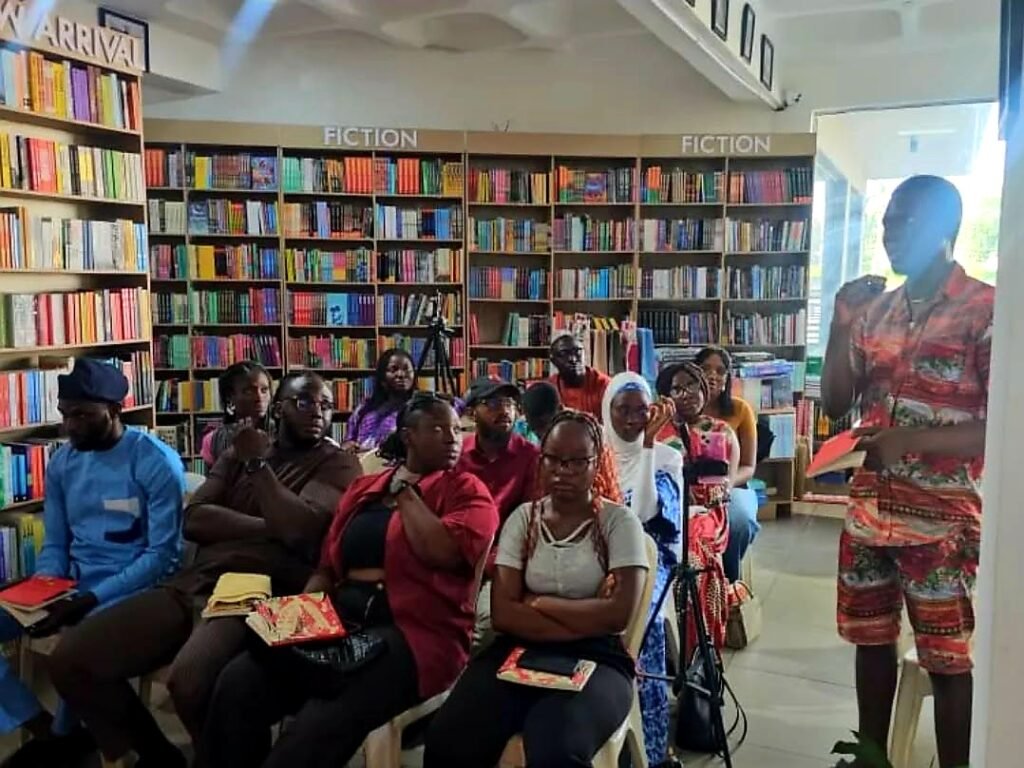
Nnamdi Anyadu’s short story collection A Meal Is a Meal was published by Narrative Landscape Press Limited in 2025. The book is a Nigerian short story collection that uses food as a lens to explore darker aspects of human behaviour, including betrayal, revenge, grief, and superstition. At the book reading and signing held at RovingHeights Bookstore, Bodija, Ibadan, on 29 March 2025, Nnamdi Anyadu read from the collection and spoke with Servio Gbadamosi about the making of the book, its themes, and his approach to storytelling. The event was organised by Narrative Landscape Press Limited. This conversation has been edited for length and clarity.
SERVIO GBADAMOSI: Before this collection, you were writing across different genres. What made you commit to food as a theme?
NNAMDI ANYADU: It was not a decision I made at the start. I was writing across different spaces, high fantasy, alternate reality fiction, different kinds of things. But then I wrote “The Mask,” which was longlisted for the Afritondo Prize, and shortly after that I wrote “Potluck Jollof,” which was shortlisted for the Isele Prize. Both were food stories. I could see that these particular footsteps were gaining traction. There was something in that space that resonated. So once I made the decision to focus on food, the ideas started coming through both research and personal experience. When you think about food in the Nigerian context, you quickly realise it is already full of stories. Superstitions about what you should not eat in certain places, beliefs about food being used to harm someone, folklore around what a guest must or must not do at a host’s table. These things are stories waiting to be shaped.
SERVIO GBADAMOSI: Some of the stories feel very grounded, set among ordinary people in recognisable Nigerian settings. Others shift suddenly into something dark or surreal. Do those darker twists arrive early in the writing process, or do they grow as the story develops?
NNAMDI ANYADU: The best ideas, for me, are the ones where I can see the ending before I begin. When I have that clarity, I write toward it. When people ask what I want readers to take from this book, my first answer is always: I hope you enjoy it. Message comes second. So when I think about how to tell a story, I am thinking about entertainment value first. And within that thinking, the shock twist is a very powerful tool. In a story like “Barbecue,” the intention from the very beginning is deception. I am actively trying to mislead you so that when the twist lands, it lands hard. The darkness is planned from the start.
SERVIO GBADAMOSI: You did mislead me completely in “Barbecue.” Nothing in that woman’s life gave anything away. Moving on, many of the stories feel like oral tales, the kind older relatives used to tell. The language is modern but something in how the stories move feels older than that. How conscious were you about drawing from oral storytelling traditions?
NNAMDI ANYADU: My general approach to writing is very conversational. I write the way I speak. I try to put the reader in the position of a friend I am catching up with and telling what happened. Even when I use a collective voice, it is as though a community is telling the story, the way gist spreads through a neighbourhood. One piece of advice from a writing workshop that stuck with me is: write the way you speak, because that is how your voice develops. If you are a Nigerian writer, you do not need to sound like someone you are not. Write like a Nigerian telling a story. On oral tradition specifically, I would say yes, but partly without being fully conscious of it. The anonymity in these stories, the way I often call someone simply “the boy” or “the wife” rather than giving names, that gives the collection a fable quality that a reviewer pointed out to me. He described it as giving the book a fabulous aura. Sometimes you do something and it is only when other readers engage with it that they show you what you were actually doing.
SERVIO GBADAMOSI: That anonymity works on two levels. The characters are unnamed and so are the places. Any city, any compound could be the setting. What kind of observer are you in everyday life? Are you always collecting things, filing them away?
NNAMDI ANYADU: The anonymity actually answers that. When I am in a social setting and something happens, I take it in and it settles somewhere. When I eventually write it, I do not need to make it about myself. I take my own lived experience and place it at a necessary distance, which frees me to use it as fiction. But I should be honest. I am not a deliberate, consistent observer the way some writers describe themselves. I am reasonably social, but sometimes my social energy drains sharply. When that happens I withdraw, I stop interacting, but I can still watch what is going on. Things surface later when I am writing, almost on their own.
SERVIO GBADAMOSI: Short stories are often described as the hardest thing to get right in fiction. How do you know when a story has said what it needed to say?
NNAMDI ANYADU: Seeing the ending before I begin is one way. But another important part is recognising that the writer does not work alone. You write, then you share with people whose judgment you trust, friends who will read the manuscript honestly, and eventually an editor who will guide you. Those are the people who can tell you that you have overwritten, or equally that you have left too much out. So while I start with a destination in my mind, I remain open to the process of refining. Sometimes what I thought was the right ending turns out to be a step before the real one. The short story has its own internal clock, and learning to read that clock happens in conversation with others, not in isolation.
SERVIO GBADAMOSI: There is a lot of darkness in these twelve stories, but there are also real moments of tenderness. Which story feels most personal to you?
NNAMDI ANYADU: Two stories hold a special place for me. The first is “Super Slumber.” I grew up in a home where dreams were taken very seriously, always treated as messages or warnings. People would tell you, do not eat in your dream. Which is a very funny instruction, because how much control do you actually have over what your mind does when you are asleep? That story was about human psychology, specifically how the mind can work something out for you without your knowing. We find out at the end that the boy’s recurring dreams about a woman bringing him food were his subconscious connecting him to a memory he had buried. His mother was in that memory. It was a kind of therapy he had not signed up for. The second is “Sak.” It follows someone who has found success and gathers children around them to share in that blessing. I wrote it partly from the memory of experiencing that kind of communal generosity as a child, and partly from noticing that it is disappearing. Someone told me after the reading that they would hesitate now before letting a child outside their own family eat in their home. That detail stayed with me, because the story is partly a mourning for that lost spirit.
SERVIO GBADAMOSI: Can you tell us something about your daily writing practice?
NNAMDI ANYADU: I write for at least one hour every morning before I engage with anything else. Before conversation, before traffic, before whatever the day demands. Part of that hour goes into preparation before I actually write: deciding how a character will be handled, what point of view will serve the story, what the opening should feel like. Then when I produce the words, I already know where I am going. The drafting follows the thinking.
By this point, the conversation had already covered the heart of the collection, but it did not feel exhausted. If anything, it opened up more room to think about the stories again. What became clear across the discussion was how deliberately he thinks about his stories, from the first idea to the final twist. Nothing in the collection is accidental. Each story is built to lead somewhere. A Meal Is a Meal did not come from a random set of ideas. It came from careful thought, observation, and a strong sense of direction. After the floor was opened, the audience stepped in with their own questions, and the conversation deepened even further.
AUDIENCE MEMBER 1: You write for one hour every day. How do you deal with writer’s block?
NNAMDI ANYADU: Honestly, it does not really happen to me, and I think that is because of how I structure the hour. Writer’s block mostly happens when you are trying to make everything perfect from the first word. Because I know I have another hour tomorrow to fix whatever I produce today, I take that pressure off myself. I write even if what comes out is rough. I developed that discipline partly from ghostwriting. When a client has paid you and is waiting on delivery, no one wants to hear about writer’s block. The question is always: what can I produce right now, even imperfectly? I can make it better later.
AUDIENCE MEMBER 2: What inspired the title A Meal Is a Meal? And if the book itself were a meal, what meal would it be?
NNAMDI ANYADU: “Potluck Jollof” was the first story I wrote for this collection, so it came before the title. But when I was pulling the manuscript together, I worked food into every story title. You can see that across the contents: “The Power of Oats,” “Tangerine Encounter,” “Chairs,” “The Recipe for Comfort,” “Forbidden Meat.” When I needed a title for the whole book, only two felt strong enough to carry it. One was “A Meal Is a Meal” and the other was “The Orange Challenge.” “A Meal Is a Meal” felt right because it plays on the idiom it is what it is, while also landing the food theme squarely. It has a curiosity to it. You read it and you want to know: what does that actually mean? And I think it captures something true about the book, which is that food here is many things at once: comfort, danger, culture, manipulation. A meal is never just a meal, even when the title insists that it is. As for what kind of meal the book would be, a seven-course dinner. It starts light, builds in tension and darkness, reaches the centre where things get most shocking, then gradually comes back down. Starters, a main course that hits hard, something quieter to finish.
AUDIENCE MEMBER 3: I noticed you move between different points of view across the twelve stories, first person, second person, collective. Was there a plan behind which narrator each story would use?
NNAMDI ANYADU: Both, actually. I did not want the collection to feel repetitive across twelve stories, and varying the perspective is one way to keep a reader engaged. But the choice of point of view in each story was also tied to the anonymity I was working toward. The first person “I” lets you tell a story without ever naming the narrator. The entire thing can unfold and the reader never learns who this person is. The second person “you” pulls the reader directly into the experience. It becomes almost accusatory. The story is being told at you, and you do not need a named character because the reader has become the character. Then the collective “we” positions a community as the storyteller, the way gossip moves, the way oral history is passed down. So the different points of view were each serving the larger interest of anonymity. And yes, they also kept things from becoming repetitive.
AUDIENCE MEMBER 4: García Márquez inserts himself into A Hundred Years of Solitude so subtly that you only notice it on a second or third reading. Was there any story in this collection where you found yourself in it, even accidentally?
NNAMDI ANYADU: After the fact, I think I was the boy in “Super Slumber.” It was not deliberate when I was writing it. But when the story was finished and I read it back, I recognised something. I grew up having very vivid dreams, dreams that felt almost like a second existence running alongside waking life. And I grew up with the same instructions the boy receives: do not eat in your dream, do not accept things from strangers in your dream. There is no way to actually comply with that, but you are still told. That tension between what you are instructed your mind must not do and what your mind does anyway is something I lived with. The story came from fiction. But I am in it somewhere.
AUDIENCE MEMBER 5: When you write, do you have a specific emotional outcome in mind for the reader, or do you let whatever feelings come, come?
NNAMDI ANYADU: It is both, depending on the story. Sometimes an idea arrives and it simply needs to be told, regardless of how you think the reader will respond. I have an unpublished story called “The Fashion Police,” set in a world where police are instituted to control how people dress. It ends badly for everyone and is very reminiscent of certain recent Nigerian realities. It was not comfortable to write, and for a long time I questioned whether I wanted to be that kind of writer. But the idea arrived, it stayed, and it would not leave me alone. So I wrote it. That said, my general instinct is to prioritise entertainment. Even when my stories take dark turns, I tend to go for the kind of darkness that shocks rather than the kind that simply saddens. A shocking twist has entertainment value. It creates that moment of gasping, of wanting to grab someone and say, you have to read this. Shock, handled well, is a form of pleasure. Horror films know this. That is usually the register I am working in, even when the subject matter is dark.
On “Super Slumber”
AUDIENCE MEMBER 6: Each time the woman in the dream appears, it seems to be at a moment when the boy needed comfort. What triggered the very first visit?
NNAMDI ANYADU: The first time was simply that he had played video games too late and forgot to eat dinner. He went to bed hungry. The woman came to feed him. It is as simple and as profound as that.
AUDIENCE MEMBER 7: The woman is always in a yellow dress. What is the significance of that colour?
NNAMDI ANYADU: I will let someone in the room answer that first.
AUDIENCE MEMBER 8: At the very end of the story, when the boy is five years old and falls asleep at his uncle’s wedding, his mother places his head on her lap and she is wearing a yellow dress. So the woman who has been visiting him in his dreams is wearing the same colour his mother wore the day he first fell asleep on her lap. It is a psychological echo. The dream figure is built from that original memory. I really love that detail.
NNAMDI ANYADU: Exactly right. Thank you.
AUDIENCE MEMBER 9: It seems to me that the mother was, in a way, praying against herself. The thing she feared was actually her own love, expressed through her son’s subconscious.
SERVIO GBADAMOSI: And if you extend that reading, what does it say about the church that reinforced her fear? The reverend, the anointing oil, the prayer sessions, all of it was being aimed at something that was essentially the boy’s memory of his mother. That is a very uncomfortable thing to sit with. And I think the story earns that discomfort.
NNAMDI ANYADU: What I would add is that not everyone will accept that reading. Many readers, particularly in a Christian or traditional Yoruba context, will insist the visits were genuinely spiritual. They will not want to hear that the mother’s prayers were aimed at the wrong thing. And a reverend who sells anointing oil for five thousand naira is certainly not going to be quick to agree that the threat was the mother herself. The story will generate real debate. I think that is a sign of how well it works.
AUDIENCE MEMBER 10: The story leaves so much open. The boy has had three food dreams: pepper soup, jollof rice, fruitcake. If there were a fourth, where would it go? Would he figure it out himself eventually?
NNAMDI ANYADU: I want to point to something in the last paragraph of section three, just before the final section begins. It says that when the woman appears at boarding school, “the residue of guilt which would have sat in his chest was absent this time.” That absence is doing a lot of work. When the boy was young, he always felt terrible after those dreams, ran to confess to his mother, carried the weight of it. Getting older, that guilt is gone. He is beginning to perceive the truth on his own. So the story is also about growing up, about the slow separation of fear from understanding. The reader who completes the story in their mind is completing an arc the boy has already started.
AUDIENCE MEMBER 11: You said after the fact that you recognised yourself as the boy. Are the dreamlike elements drawn from your own experience?
NNAMDI ANYADU: The story is fiction, not autobiography in the direct sense. But when I re-read it, I recognised something familiar. I did grow up having very vivid dreams, dreams that felt like they had their own reality. And I grew up with the same instructions the boy receives: do not eat in your dream, do not accept things from strangers in your dream. That impossibility, the instruction to control what your sleeping mind does, and the guilt that follows when you inevitably fail, is something I lived with. The story came from fiction. But I am in it somewhere.
A Meal Is a Meal by Nnamdi Anyadu is published by Narrative Landscape Press Limited (2025, 140 pages) and is available for purchase at www.narrativelandscape.com. The book reading and signing was held at RovingHeights Bookstore, Bodija, Ibadan, on 29 March 2025, and was organised by Narrative Landscape Press Limited.