
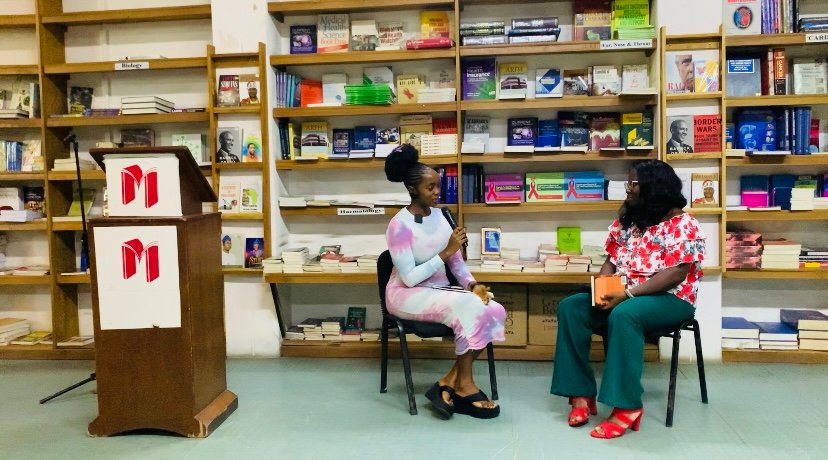
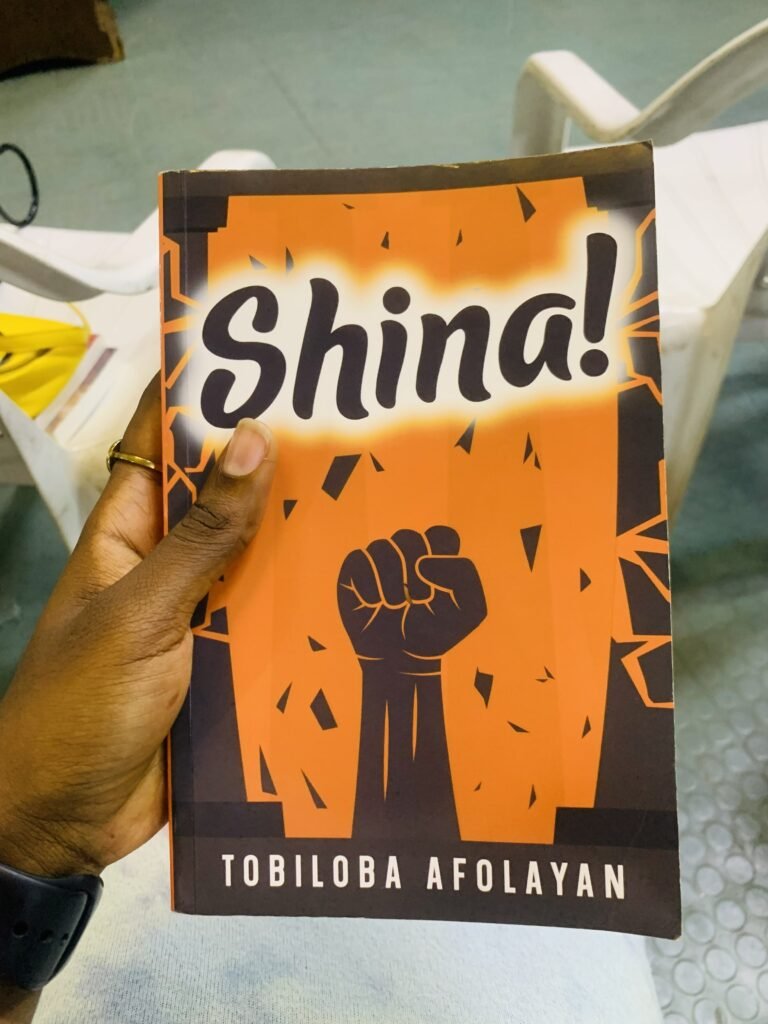
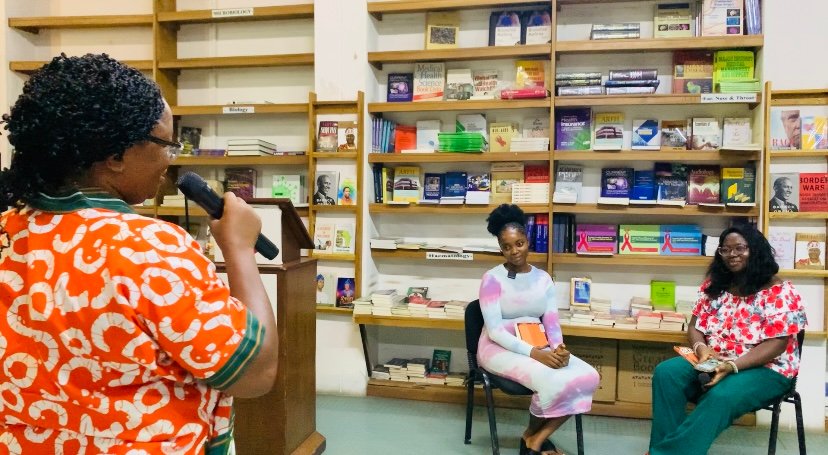
Tobiloba Afolayan’s novel Shina! was published by Paperworth Books in 2025. The book is a contemporary Nigerian retelling of the Samson and Delilah story, set against the backdrop of political unrest, public activism, and personal faith. At the book reading and signing held at The Booksellers, 52 Magazine Road, Jericho, Ìbàdàn, on 11th April 2026, Tobiloba read from the novel and sat with Adedolapo Ogunwuyi to talk about the making of the book, its characters, and the ideas driving the story. The event was organised by Paperworth Books and anchored by Kayode Sanni. This conversation has been edited for length and clarity.
ADEDOLAPO OGUNWUYI: Good afternoon, everyone. I have already told you what I think about the book. Now I get to ask the person who wrote it the questions I have been sitting on. Welcome, Tobiloba.
TOBILOBA AFOLAYAN: Thank you.
ADEDOLAPO OGUNWUYI: Of all the Bible stories you could have retold, why Samson and Delilah? What was it about this particular story that drew you to it?
TOBILOBA AFOLAYAN: When I came up with the idea, I was already thinking about Bible retellings in the romance genre, and the Samson and Delilah story has always stood out to me in scripture. I am also a fan of Very Dark Man and everything that has been happening in Nigeria right now, and that combination just came together naturally at that time. I love the story of someone powerful being brought down through love and loss. That was the reason behind it.
ADEDOLAPO OGUNWUYI: And why Nigeria specifically? The setting feels so particular. It does not feel like a choice you made at a desk. It feels like the story demanded it.
TOBILOBA AFOLAYAN: Because I am Nigerian, and I live here, and I know what is happening. It was easy for me to situate the story in Nigeria because right now, we need someone like Shina. We need someone like Samson. I was also thinking about people like Very Dark Man, people who stand for truth and justice in this country. And Nigeria was simply the only place I know well enough to write about honestly.
ADEDOLAPO OGUNWUYI: You said we need someone like Shina in Nigeria. Do you actually believe someone like that exists here?
TOBILOBA AFOLAYAN: We already have one. Very Dark Man. We just need more like him. People who are brave enough to look at the truth and call out corrupt leaders. People willing to say what needs to be said. We simply need more of them.
ADEDOLAPO OGUNWUYI: That brings us straight to the character himself. Shina is divinely called and dangerously flawed at the same time. Those two things are in direct tension with each other. How did you write a character who carries both without letting one cancel out the other?
TOBILOBA AFOLAYAN: Shina is powerful and flawed, just like any real hero. Every hero has to have a weakness. That is what makes them human. I was able to write him because we see people like him every day in Nigeria. We admire them, we hold them up based on our own perception of them, but of course they all have their secrets too. Those truths can either build them or turn us against them. I was able to hold his strength and his weakness together because I am also human. I have my own weaknesses. It was simply a matter of putting myself in his shoes.
ADEDOLAPO OGUNWUYI: Now let us talk about Lilah. She was not the villain I expected. I kept trying to understand her choices, and I found myself almost on her side at points, which was very uncomfortable. Was she a difficult character to write?
TOBILOBA AFOLAYAN: Yes. Lilah was a very complicated person to write because she was fighting so many things at once: her feelings for Shina, her ambition, her hunger to reach the peak of her career. She was trying to balance all of that. There were moments in the writing where she came across as completely selfish, and then moments where she was deeply loving, and then came the point where everything crashed and she had to stop and think carefully about what the right thing to do was. I had to pause many times and ask myself, what would I do if I were Lilah? She felt like two different people at the same time, and that was not easy to hold together on the page.
ADEDOLAPO OGUNWUYI: And this is where the romance really gets complicated, because the love story is real on both sides and yet it is heading somewhere destructive. How did you make that feel genuine rather than forced?
TOBILOBA AFOLAYAN: Honestly, I simply wrote their love story as if it were a normal romance novel. I did not think about the betrayal while I was writing those scenes. I focused entirely on the feelings, the dates, the surprises, the small moments of tenderness. Those parts came easily to me. If I had been writing their love story while simultaneously thinking about how it would end, I would have gotten confused and the emotion would have been lost. So, I gave them a real love story first, and let the rest follow from that.
ADEDOLAPO OGUNWUYI: The story frames love as both a battlefield and a catalyst for change. What does this book ultimately say about the power or danger of love?
TOBILOBA AFOLAYAN: For Lilah, love became a catalyst for change only after everything had fallen apart. It was in the wreckage of it that she realised how deeply she loved Shina, and that realisation was what brought her back to her conscience and pushed her to do the right thing. She put aside even the career she had been so desperately chasing. That was her transformation. For Shina, love was a battlefield, and unfortunately one he lost. Loving Lilah was a risk, and it led to his downfall. So, love in this story functions both ways: it redeems and it destroys, depending on where you are standing.
ADEDOLAPO OGUNWUYI: This story deals with betrayal on multiple levels: romantic, political, and spiritual. Which of those was the hardest for you to write?
TOBILOBA AFOLAYAN: Political betrayal. I am not deeply familiar with the mechanics of politics, so writing all the political dimensions of the novel was genuinely difficult. I could not always say with confidence what the ripple effects of a particular action would be. The romantic and spiritual betrayals came more naturally to me. But the political parts required a great deal of thinking, and I struggled with them.
ADEDOLAPO OGUNWUYI: The novel looks closely at what fame does to a person’s sense of purpose, especially in a politically charged country like Nigeria. What is your view on that?
TOBILOBA AFOLAYAN: We can see what fame costs right now, all around us. Some of our politicians promise everything when they are seeking power, and then they enter that office and forget it all. My mother once asked me whether, when presidents get into office, something happens to their sense of reasoning. And I think that is exactly what power and fame do to people who do not have the fear of God. Fame becomes controlling. It takes over. Unless someone is genuinely anchored in something bigger than themselves, fame will drive them. It keeps them chasing the spotlight, doing whatever it takes to stay there.
ADEDOLAPO OGUNWUYI: The faith thread in this book never felt like a sermon to me, and I really appreciated that. How did you write a man confronting the God he abandoned without it slipping into something preachy?
TOBILOBA AFOLAYAN: I am a Christian, and I wanted to write a book that speaks to everyone, not just to Christians. With that in mind, I made a deliberate effort not to make the faith element too heavy. But I still needed to pass a message. And at the end of the book, I think that message comes through clearly, without forcing it on anyone.
ADEDOLAPO OGUNWUYI: The blurb promises redemption. But Shina loses nearly everything before we get there: his name, his purpose, the people who believed in him. What does redemption actually look like for a man after all of that?
TOBILOBA AFOLAYAN: Redemption, for me, is reconciliation with one’s maker. Even in his brokenness, Shina was able to find his way back to God. Even when the worst happened to him, there was a kind of peace in it. Just like Samson, who was willing to die alongside his enemies, you can see that he had already made his peace. He had already laid down his guilt and asked for forgiveness. For me, redemption is simply putting everything aside and returning to where you came from.
ADEDOLAPO OGUNWUYI: Every writer has a process. When you write, do you work toward an ending you already know, or does the story lead you?
TOBILOBA AFOLAYAN: I do not write toward a known ending. I did not know how Shina! would end when I started. I knew the general shape of the story, that it would be a retelling, that certain things would happen, but not how or where it would all land. My process is to start with an outline of what I can see clearly in my head at a given time, then flesh that out, take a break, think about the next section, and continue from there. It is a gradual building rather than a march toward a fixed destination.
ADEDOLAPO OGUNWUYI: If readers walk away with one central question, whether about power, love, or destiny, which would you hope it is?
TOBILOBA AFOLAYAN: Destiny. Because destiny is mentioned throughout the novel, and I believe in it deeply. Even without love, we are still moving toward the fulfilment of something larger than ourselves. Shina’s destiny is bigger than Lilah. And just as Samson’s destiny in scripture was bigger than Delilah, the betrayal and the downfall in this story did not end Shina. At the end of the book, there are still things coming for Shina. Destiny carried him through.
ADEDOLAPO OGUNWUYI: There is a character in the book called Phil Thompson, a presidential candidate. When I was reading him, I kept seeing a very real figure in Nigerian politics. How did you write that character so specifically?
TOBILOBA AFOLAYAN: Because of social media. I will not mention any names, but the person you are thinking about is the same person I was thinking about. I mirrored Phil Thompson after that figure. You will not fully understand who Phil Thompson is or who he represents in Nigeria until you read the book.
ADEDOLAPO OGUNWUYI: Can you tell us about the title? The exclamation mark in particular feels deliberate.
TOBILOBA AFOLAYAN: Yes, the exclamation mark can be read in a few ways. It can be the crowd chanting his name. It can be a call from God to Shina himself, in the moment when he has lost everything, reminding him that he can still come back. And it can also be a call to all of us. You are Shina. I am Shina. We do not need to wait for someone to come and save us. Whatever good we are able to do, one day at a time, is part of the change. Those are the layers in that title.
At this point, Tobiloba had answered every question I had prepared, and honestly, I could have sat there and kept going. What I kept noticing across the conversation was how consistently she brought everything back to something real, Nigeria, people she actually knows, situations she has actually lived through. The book did not come from a writing exercise. It came from paying attention. After I closed the floor, the audience had their own questions, and they were good ones.
AUDIENCE MEMBER 1: My question is about the writing process. You have love, betrayal, and politics all in one novel. How did you manage to hold all three together without one overwhelming the others?
TOBILOBA AFOLAYAN: I write using an outline, and I cannot write without one. When I am working on the outline, I put everything I can see in my head into it: every theme, every scene, every thread. That gives me a map. From there, I am able to explore each theme across different conversations, settings, and chapters. The outline is what made it possible to hold everything together. Without it, I would have reached the end of the book and realised that half of what I meant to write was never there.
AUDIENCE MEMBER 2: I noticed from your biography that you have a background in content marketing and digital campaigns. Is writing Shina! your way of lending your voice to what is happening in Nigeria right now? Is it a statement?
TOBILOBA AFOLAYAN: Yes. I am a Nigerian, I live in Nigeria, and I know what is going on, some of which you will find reflected in the pages of this book. So yes, this is part of me writing about what is happening and lending my voice to it at the same time.
AUDIENCE MEMBER 3: Is the book purely fiction, or is some of it drawn from real life?
TOBILOBA AFOLAYAN: The book is a retelling of Samson and Delilah, and we have Nigerianised it. But on every page, you will find something familiar, something that you have experienced or are still living through as a Nigerian. Literature is a mirror of life, and this book is a mirror of what is happening in Nigeria. That is the intention.
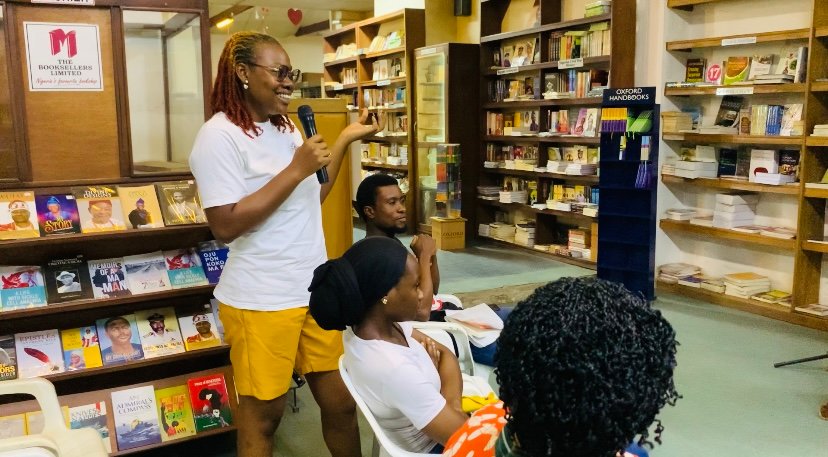
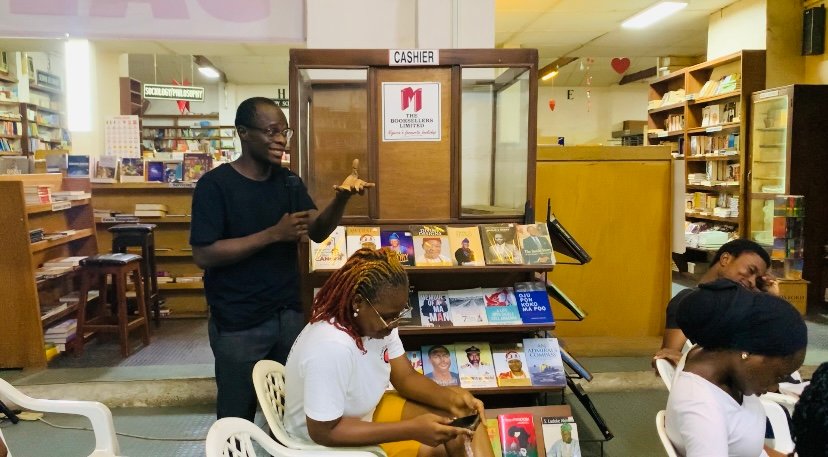
AUDIENCE MEMBER 4: When it comes to Lilah, is there anyone in Nigeria you used as a reference for her character?
TOBILOBA AFOLAYAN: Someone asked me this during a live session as well. Honestly, there was no specific person I mirrored Lilah after. I do not know enough about Nigerian journalists in that particular sense. What I did instead was go back to Delilah herself. Delilah could not have betrayed Samson without wanting something in return. She betrayed someone powerful because something was being offered to her that she valued more. And for someone with the drive and ambition of a journalist, that something could only be career-defining. So, I drew Lilah from Delilah directly, not from anyone in Nigeria.
AUDIENCE MEMBER 5: The original story has always puzzled me. How could Samson, someone that intelligent and powerful, not realise that Delilah was working against him? If someone keeps asking about your secret, that alone should raise a flag. How did you handle that in the book to make it believable?
TOBILOBA AFOLAYAN: That part gave me trouble too. I even stopped at one point and thought, I need to step away and rethink this. What I did was introduce a friend who raises the warning with Shina directly. He tells him, this person is asking too many questions. Why are you not seeing what is happening? But Shina has never truly been in love before. He has kept women at a distance his whole life, treating relationships as something casual and temporary. When Lilah came along, it was the first time he experienced something that consumed him completely. And when love is that powerful, it can silence even the loudest warnings. He simply did not have the mental space to doubt her, because losing her was not something he was prepared to consider. I also worked hard to make Lilah appear as innocent as possible, so that the reader, like Shina, would find it difficult to suspect her.
AUDIENCE MEMBER 6: My question is about how you brought the spiritual, the political, and the romantic together in one book. To what extent does the spiritual element come into play, and how did you balance all three?
TOBILOBA AFOLAYAN: In the original Samson and Delilah story, the spiritual dimension is central. Samson operates within a world where God’s presence is very real and very active. So, when I brought the story into a Nigerian setting, I knew that spirituality had to be there, because for Nigerians, God is not an abstract concept. Shina is a child of prophecy. There was a word spoken over him at birth, and that word is the thread that runs through his entire life. He is not deeply spiritual in the sense of daily religious practice. If he were, he would not have made the choices he made. But he is always aware that God gave him to his parents for a purpose, and that awareness is what keeps him returning to something larger than himself, even after he has lost his way. The political side was the hardest for me. I had to research and think deeply about cause and effect. The romance, on the other hand, is where I am most at home. It took me a full year to write this book, and though it was a demanding process, it was deeply satisfying.
AUDIENCE MEMBER 7: Where do you normally get your inspiration when you write?
TOBILOBA AFOLAYAN: I draw inspiration from things happening around me, from the realities of life in Nigeria, from what I am reading at any given time, and sometimes from my dreams. There are mornings I wake up with something in my head and think, this needs to be a story. Those are the places my ideas come from.
Shina! by Tobiloba Afolayan is published by Paperworth Books and is available for purchase at www.paperworthbooks.com. The book reading and signing was held at The Booksellers, 52 Magazine Road, Jericho, Ìbàdàn, on 11th April 2026, and was organised by Paperworth Books.