
Thairsty: A Short Story from In the Middle of All This Fire


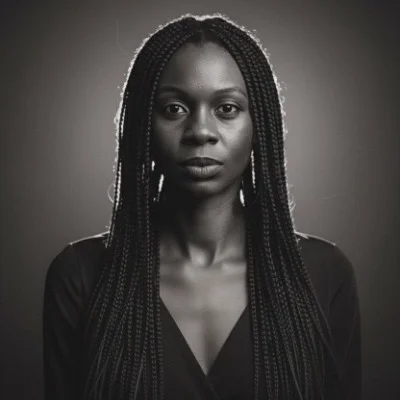
Thairsty by Olubunmi Adesuwa Ajiboye is a short story from In the Middle of All This Fire, the Noirledge anthology of fiction that reflects on the intimate tensions of contemporary African life. Set against the backdrop of Nigeria’s Independence Day, the story follows a young woman navigating the ordinary yet loaded rituals of hair, beauty, family expectation, and migration dreams.
Through humour, cultural observation, and restless interior monologue, Ajiboye captures the quiet anxieties of adulthood in a country where personal choices are constantly weighed against social pressure, economic uncertainty, and inherited ideas of success.
Read on to follow a single, chaotic day in Taiba’s life, where thoughts about natural hair, motherhood, visas, money, and the future collide in ways both familiar and painfully revealing.
Thairsty
Olubunmi Adesuwa Ajiboye
IT IS OCTOBER 1, INDEPENDENCE Day. I wake up from a dream, foggy now, but I smell Iya Mope, my hairdresser, all over me. If I dream about someone I know, I smell them around me when I wake up. But Iya Mope is good people. I have never had one negative dream about her if at all I have dreamt about her before. No, this is definitely a result of last night’s three-hour, googly-eyed feast on Pinterest: goddess locs; passion twists; passion fruits of dream hairstyles; Marley hair; goddess hair; long loc textured twines of hair falling down my back; jumbo twists; box braids and baby hairs laid down to mouth-watering perfection..help! Sensory overload. But I’m hooked. Side braids; side twists; braids for days; braids for countries—Senegalese, Ghana; rows of corn, braids sans knots—which one will I do? Me with my thick 4C hair that stands woolly on my head, like a shapeless cotton wool dome. What is this whole business of giving hair textures numbers and alphabets sef?
I have forgotten my dream. This is dangerous. Maybe I should soak all last right’s dreams through the blood of Jesus since I don’t remember anything. It is what my mother would advise me to do. I attempt to reach back in, flipping through channels of conscious and unconscious memory, but I keep bouncing back to the present, keep getting pushed back to the here and now. My hand naturally knows to crawl to my phone beside my head and in Igo, where lashings on Twitter over Buhari and Independence Day blues abound. Tut-tut. I know better than to succumb to this hand and phone automated relationship of my waking mornings.
Suddenly, I get a quick mental flash of myself running non-stop through the expanse of my primary school field. No, not another back-to-my primary-school-field dream. Dread plops heavily from my gullet to my stomach like a sack of cassava salt and spreads its tentacles all through my nerves. This dream is certainly a reflection of my current state: jobless, broke, unmarried, recently denied a visa to travel out, still living with my parents 35-spirit of backwardness. I make a mental note to rummage through the cartons of books and paper paraphernalia at the bottom of my wardrobe for my last-owned copy of Our Daily Manna, bought circa 2007. The prayer bullets at the back of it are very apt for these recurrent back-to-primary-school or finding-myself-in-a-boarding-school-hostel dreams. I will wake up at midnight to do the needful. I attempt to set my alarm.
My mother enters without knocking. The thought of her perched and her urine flowing down my newly washed toilet bowl summons an accustomed headache, and my stomach boils with frustration. Why can’t my toilet be my toilet and my room my room?
“When will you make your hair?” she asks, picking through my dry, knotty hair with her fingers.
“It’s so stiff. What happened to all those your expensive hair products? she asks me in Yoruba. I know she is not mocking me, but weirdly commiserating with me in the natural disbelief that anything so costly would be less-than-efficient in its purported benefits.
“I just woke up. I haven’t sprayed it with water this morning,” I reply.
Natural hair needs moisture. This is the mantra of the natural, black hair community the world over. Your spray bottle is your hair’s best friend. So are the mandatory silk scarf or hair bonnet and the old tee-shirt to dry hair after shampooing, all to preserve hair’s moisture and protect her sensitive ends. Never mind that I have none of the above and prefer to lift water with my cupped palms onto my plaited hair when I do remember it is dry, sleep with my old, not-so-silky scarf which I’ve had since I was a teen and towel my hair with a regular towel—complete with intestinal villi.
“Okay o.” She is unconvinced.
You should call Iya Mope and let her know you are coming. You’ve been carrying this hair like this for the last three months. Let your face shine small ehn. I will send small money to your account.”
This hair, being my hair, sprouting out of my roots; this face, refusing to shine, darkened continuously by the sun unlike the rest of my body, and this small money, which I will gladly accept since I feel no shame receiving money from my mother at this age—she is ‘mommy’ after all. I know I should be the one giving her money. I know she barely gets enough sleep at night from praying for me to find a good husband so that she can have a place to go and do omugwo for grandbabies like her friends at church; and I know she has become too skinny from endless fasts for this one child who is failing miserably at launching in comparison to the others.
Who send me message? Natural hair equals money, and anybody who has attempted to keep theirs knows this—attempted to keep theirs? Shouldn’t this be disturbing? Not as much as I thought it was six years ago when I first transitioned. And having done this for six years, I wish I had the requisite amount of indifference to go back to relaxing it. But I can’t. I’m too caught up in the politics of black hair, and too afraid of possibly getting dangerous chemicals into my body even though I must have ingested massive doses of them for years since I first started getting jerry curls as a kid.
But I want to rest from all the wahala; the wahala of wash days, and co-wash days, and deep conditioning days, and aching arms from parting and plaiting, and massaging and washing, and combing and finger-combing, and two-strand twisting and flat twisting, and finger-coiling and finger-picking. Was my hair this complicated for mother to handle before she bought my first relaxer kit at age five? I want to ask her, but suddenly l hear a cacophony of voices from outside, through my window. Loud wails start to rend the air. My mother dashes out of the bathroom, toothpaste froth all around her lips. Our eyes meet questioningly as if on cue, and we bolt outside at the same time. I make a mental note to remind her to flush the toilet when we return, as I do not want to mix my pee with somebody else’s as though we are in boarding school and sharing a pit latrine.
Outside, there is a traffic jam, a portion of which is right in front of our gate. People are either running or jumping or crying or hitting their hands on their chests or swaying with their hands around their bodies or with their interlocked hands sitting atop their heads. I look ahead, and a trailer stands a few metres away from a seemingly headless body. I look away in shock, burying my face in my mother’s neck. The dead man’s car had been grazed at the side by the trailer whose driver refused to stop to acknowledge his fault. My father explains this as mother serves him breakfast of moin-moin and akamu. I away from the food, nauseated, as the picture from the road floats back into my consciousness. Angered by the action or inaction of the driver, he flagged an okada, got on it, and asked the rider to give the trailer a hot chase. As he got closer, he alighted from the okada and hopped on to the side of the moving trailer determined to give the driver a piece of his mind. But in a moment, his grip weakened. His hand shipped. He fell. The tyres were still in motion, and he was gone, snuffed out.
The consensus outside is that he was bewitched; because no sane person would go as far as he did to prove a point. Father believes he was set up to self-murder. Mother agrees. For her, this is classic, wait-for-the-perfect-moment-to-get-your-target-to-be-the-architect-of-his-own-misfortune. And what better time than the first day of the month—October 1st for that matter? I think about his children sitting in the car, waiting for him to return. Why didn’t he just let it slide? If it were you, would you? I ask myself. It makes no sense. None of it does. So, I am inclined to agree with them that he was bewitched. I quickly type a new WhatsApp status: Are all truck drivers insane, or is it just the ones in Nigeria?
I pick up my towel and my jar of black soap, another expensive purchase to remedy the sandpapery, hyperpigmented, darkening skin of my face so that men can find me attractive again. As I step into the bathroom, the thoughts overflow, it’s something about this place. This is where I think about the reclaiming of black soap while I am on the subject of bewitchment. Gone are the days of the twinning black soap and native sponge; a staple of the native doctor or woli or alfa, for cleansing and washing off failures and bad luck and misfortunes and spiritual smears from desperate supplicants. I’m glad we’ve found better uses for black soap. As I make my way out of the shower, I pick my steps carefully for fear of my wet dunlops sliding down the staircase, taking me with them in a headlong fall. Better me than my old parents. Wait, What? Why have I allowed my mind to become a haven for morbid paranoia? And why are natural hair products so expensive, ehn? The made-in-Nigeria—ones the ones I put all my trust in because I am guaranteed of locally sourced, chemical-free, and preservative-free ingredients—leave me in a world of pain, poring over my important-things-to-buy list and agonising about how a 20 ml bottle of herbal, hair growth oil swiped half of the pocket money my younger sister in Canada sends me at the end of the month.
One hand pulls up my jeans, the other scrolls through hair photos on Pinterest, pondering which one falls within lya Mope’s capacity. Iya Mope may not be the Holy Grail hairdressers, but she is my Holy Grail, the archetypal needle in a haystack. I know what I went through before I found her, this hairdresser who does not mind working with non-straight hair; though every time she braids my hair, stray strands of hair on my hairline are guaranteed to remain standing, un-incorporated into the braids. She chucks it down to the non-malleability and stubbornness of natural hair. I wonder why we emphasise the naturalness of our hair. You never hear white people refer to their hair as natural. It is a tedious designation. A thing is a thing is a thing. If it pokes out of my roots, it’s what it is right, simply hair? Iya Mope conveniently reassigns blame for her inefficiency and encourages me to always pat the stray hairs down with edge control—that scam. Lord knows how many times, worn toothbrush in tow, I have tried to sleek down my so-called baby hairs, but they keep bouncing back in their indomitable style. Do you know what else is a scam? That wash-and-go business. Truth be told, nothing keeps this woman’s hair down except an army of determined bobby pins.
Still, I have made peace with Iya Mope’s limitations because she knows how to handle natural hair like a basket weaver knows how to handle her business. She never complains about pain in her fingers from trying to keep my hair down while Ghana-weaving it, she never charges me more for the supposed pain, and she never tells me to consider “relaxing” my “virgin” hair as if I came in there without the knowledge that that was an option. lya Mope understands the struggles of this Nigerian woman’s hair. Not like these African American YouTubers with their curly, compliant hair; DNA’d strands infused with European and Native American genes, hair willing and able to be entreated by all gels and butters and puddings and curl creams, able to be slicked down, able to grow way past the shoulders and able to defy the gravitational pull of shrinkage. They keep selling me the dream hair over there on the Tube, and l am a gullible shopper.
Bandits Kill 50 Including Women and Children in a Village in Akure.
“Why the euphemism?!” I overhear my father roar at the radio set. “Why not call them what they are? Killer herdsmen!” His voice drops as he moans his worry to my mother about his only headache—this daughter still living at home, this daughter still here in this country that has no future, no security, no light, no jobs, no humanity, no guarantees, no hope. I pick up my bag and make my way out quietly. Mother, more perceptive than a wall with ears, soon shows up behind me before I cross the gates.
“Taiba, I want you to start saving to apply for another visa, this time try Canada. The US is hot now; Trump doesn’t want to see anybody. You hear?”
I look at her face, the lines of age crisscrossing leather. I want to tell her I wish I could snap a finger and fulfil all her and dad’s wishes for me, for both their sakes and for my desire to exist without the need to live up to anybody’s expectations. But I don’t have the heart to. So, I remind her, “Mommy, what money do I have to save?”
At lya Mope’s, we look at hairstyles together, and anytime I point to something I like, she gives me reasons why it will not work with my hair; or she tells me the extensions or attachments used are not sold in Nigeria. I already know that’s salon-speak for inaptitude. Too tired now to fight, I choose something less complicated. Or so I think.
“Ah aunty, you will not use attachment, only your hair?”
“Yes,” I reply proudly.
“It will not be fine o. It will look rough o.”
“I don’t mind.”
“Toh.'”
As my hair would be the representation of her craftsmanship everywhere I go to, she continues to ask me if I’m sure about this, odindi sisi carrying simple twists liable to earn both the carrier and the maker ridicule. But I insist. When we are done, she hurriedly reaches for a bottle of mousse, but I intercept her hand, “No, leave it like this.”
I love the unevenness of it, the material texture of it—firm on the hand, not a will-o-the-wisp but certain on the head—static, impolite, inconsistent.
This is the me I want to be unashamed of, and many the days I am. But on the days I am ashamed, feel like a failure and for not being able to replicate what I see on Pinterest and YouTube, I know I have long gone and done it, swapped one colonial master for the other. Long and bone straight is no longer my eternal longing, curly is; coily is; kinky curly is: spiral is; slicked down in tiny, wispy waves is. How did I get here, wanting to be like my sisters in America and the Caribbean with whom I maybe share varying fractions of DNA or genes once removed or genes far, far removed? I don’t know. But I know I’ll be back there on the black streets of Pinterest and YouTube, an accomplice of the thairst trap, looking for my next fix.
OLUBUNMI ADESUWA AJIBOYE is a writer, editor, screenwriter, script editor, content producer & aspiring filmmaker who loves to refer to herself as a creative empath. Professionally, she has worked as a journalist, written for TV, is an alumnus of the Africa International Film Festival Sereenwriting class of 2016 and was a member of the 2017 Africa Movie Academy Awards College of Screeners. Her film reviews, non-fiction and fiction pieces have been published on Naija Stories, Sabinews (now 1st News), The Lagos Review, and The ScriptLab. Olubunmi is a proper movie buff whose current obsession is South Indian cinema and Indian cinema soundtracks. She lives and works in Ibadan, Nigeria.