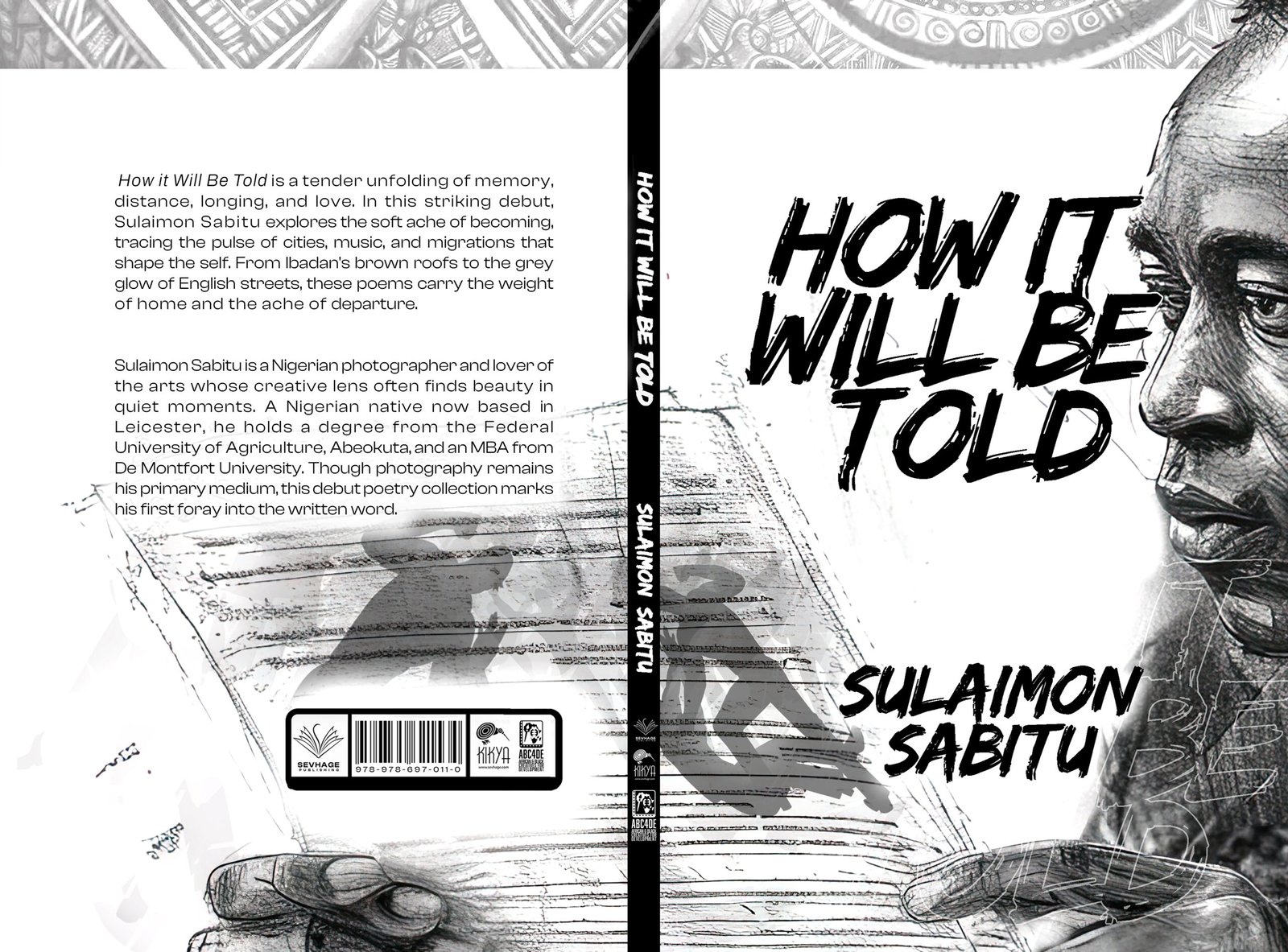
Memory and Culture In Sabitu’s ‘How It Will Be Told’: A Review by Servio Gbadamosi

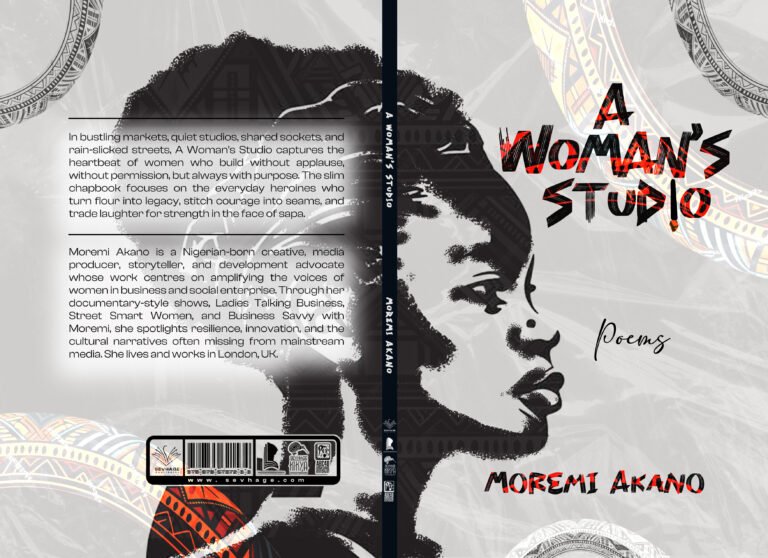
In an era when identity is increasingly mediated by global images and digital noise, the need to return to the intimacies of place and ancestry has taken on renewed urgency especially with younger authors. More African artists have taken on this mantle with great evidence showing on the poetry scene with such examples in Nigeria as Su’eddie Vershima Agema in his Memory and the Call of Water, Adedayo Agarau in The Years of Blood, and Oko Owi Ocho in Now that I sing God into stones, and Agatha Aduro Agema in The Enchanting. There are also contemporary trappings evident in works like Moremi Akano’s A Woman’s Studio and Sandra Hitarh’s The Voice of Your Village that blend the historical and current into a tome readers can read through.
It is this space that Sulaimon Sabitu occupies with his debut collection, How It Will Be Told, a chapbook that borders on reflection and resistance, while bringing in a keen sense of cultural texture that shows the book as an archive fusing memory, place, and belonging. The book weaves personal reflections with the collective memory of place, particularly Ibadan and the larger Yoruba cultural cosmos. The work shows a compelling dialogue between selfhood, community, and the layered histories that shape contemporary existence.
From the opening poem, ‘In the Beginning,’ Sabitu signals the cosmological depth of his exploration. The reference to clay, “I, little as I was blessed with / The ability to sync with clay” evokes the Yoruba creation myth of Ọbatala moulding humans from earth. There is an acute awareness of the interconnectedness between the self and ancestral soil, a theme that pulses throughout the work. The poet’s love for Ibadan is not merely geographic; it is spiritual, woven into the fabric of his identity like the famed brown roofs themselves.
Sabitu’s language oscillates between the lyrical and the conversational, often achieving a chant-like quality that echoes oral traditions. His ‘Ode to the Brown Roof’ and ‘Ode to the City of Love’ stand out as love letters to Ibadan, portraying the city as sanctuary and crucible. These poems do not simply romanticise the city; they acknowledge its complexities, its colonial legacies, its histories of struggle and resilience. The repeated invocation of warmth, home, and communal embrace subtly mirrors Yoruba ideas of agboole, the collective household where kinship and care are central.
A defining characteristic of this collection is its cosmopolitan yet deeply rooted voice. Sabitu’s engagement with themes of music, memory, travel, and longing, as seen in ‘Music, One for Travellers,’ and ‘Ode to Music’ suggests a soul constantly in motion, negotiating the tensions between rootedness and flight. The poem ‘Cycle’ encapsulates this beautifully, as the poet meditates on fate, destiny, and the Yoruba philosophy of akúnlẹyàn, akúnlẹlà, and àyànmọ (chosen destiny, negotiated destiny, and inescapable destiny).
Moreover, the poet demonstrates an astute understanding of the fragility of human experience. In ‘The Petals will Not Be Here for Long’ and ‘Blades,’ Sabitu reflects on transience and the fine line between protection and harm, images that are poignant within a Yoruba worldview where the balance of forces (good and malevolent) requires constant negotiation.
What makes How It Will Be Told particularly powerful is its subtle but insistent assertion of love as a form of resistance. The poet’s repeated declarations, “Loving you is the greatest act of worship” (‘The Simple Things of Love’), resonate with Yoruba notions of ifẹ as both personal and cosmic duty. Even the poems that speak of exile, silence, and ache (‘Our Communal Ache,’ ‘Tell Me How Much Silence You Contain’) return to this truth: that love, in its many forms, sustains and redeems.
Sabitu’s style, while largely free verse, carries the cadence of Yoruba oral poetry (ewì), with its reliance on repetition, invocation, and the musicality of everyday speech. There is also the presence of visual poetics, with spatial arrangement on the page suggesting pauses and silences that mimic the performative mode of indigenous storytelling. This makes reading the collection akin to listening to an akọọni (traditional narrator) who understands the weight of voice and breath.
However, the work does not seek to overly explain itself. It trusts the reader to feel, to listen beyond the literal. This is both a strength and a gentle challenge. Some poems, dense with imagery and elliptical in narrative, may frustrate a reader seeking linearity. Yet, as a scholar attuned to Yoruba aesthetic frameworks, I find this indirection faithful to a cultural logic that values layered meaning and multiplicity of interpretation.
In sum, How It Will Be Told is a tender, thoughtful offering that bridges personal history and collective memory, individual longing and communal belonging. It contributes significantly to contemporary Nigerian poetry by reasserting the importance of place, ancestry, and love in a rapidly shifting world. For readers willing to dwell in its quiet intensities and its luminous evocations of Yoruba life, it offers a rich, rewarding experience.