Archiving Her Hustle: A Review of Moremi Akano’s ‘A Woman’s Studio’ by Servio Gbadamosi

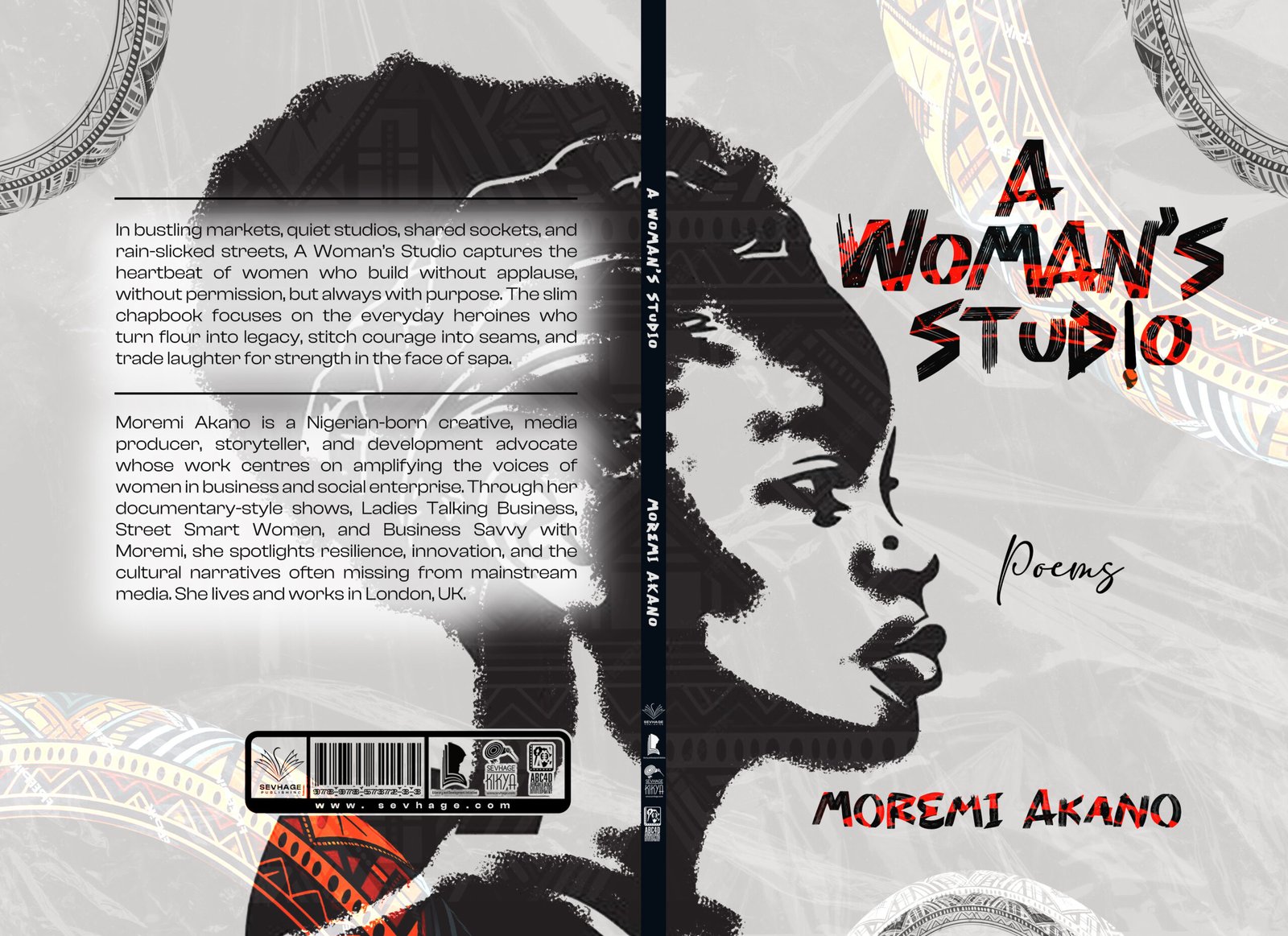
Poetry is a tool that has been used by several people to meet different needs, and in the hands of a skilled practitioner becomes a fitting buffet that readers will relish. Moremi Akano’s A Woman’s Studio is a chapbook of twelve short poems that capture the spirit of the author’s enterprise as a broadcaster and artist that seeks to highlight the heart of businesses and the community, particularly those of women.
Across twelve compact poems, Akano constructs what feels like a gallery of individuals who have built and sustained whole economies. Thus, one sees that the title is in itself a quiet metaphor where the studio is beyond a place where art is made. It becomes a street corner where a makeup artist first found her light, the kitchen where a baker turns sugar into strategy, the period where a woman has a business day beyond the conventional 9-5, to the last minute of day when she finally ‘sleeps with faith like a light/because miracles sometimes appear after midnight” (15).
Akano’s style leans towards a minimalism that sometimes mirrors the material conditions of her subjects. There seems to be a deliberate informality in the phrasing, as if we are eavesdropping on conversations rather than reading formal verse. The structure is open and free-flowing, resisting rhyme or fixed meter. The poems find their rhythm in the cadences of speech, the familiarity of Nigerian urban life, and the internal logic of memory. In this way, Akano offers something close to poetic storytelling that is lightly lyrical and rooted in lived truths.
The language is inviting and unpretentious, reflecting an impulse to document rather than dramatise. Some of the most striking moments come not from metaphor but from the clarity with which they describe ambition. In ‘The Woman Who Didn’t Wait’ (14), a young woman launches a business not with a grant or fanfare, but with pocket money and urgency. The person in the poem holds on in faith, praying in addition to her hard work, and being persistent. As the poem notes, “…many times/that alone, is simply/Enough.” In the poem, ‘Eko is a Woman’ (8), we see Lagos (also known in many parts as Eko) take the personalisation of the women on the city’s streets. The city thus features as backdrop and character, one that is alive, bustling and contradictory. It is a city of relentless movement, where hustle is not only expected but ritualised, mainly by these struggling women. These are women who hustle, “Market Queens, bakers, shoemakers/each one grinding through rain and NEPA failure.” One notes from this poem and others, that there is a cultural texture that gently threads through the collection.
What makes this chapbook particularly resonant is how it echoes and adds to a tradition of African women’s writing that finds strength in the ordinary. Readers might find thematic kinship with the works of Grace Nichols, Ama Ata Aidoo, or even early Chimamanda Adichie, especially in their shared attentiveness to domestic economies and female agency. Readers might also notice the spirit of Warsan Shire’s exploration of [women’s] everyday survival and Sindiwe Magona, who honours the labouring lives of African women without stripping them of nuance.
There are places where one senses the poems might have lingered longer or reached deeper, perhaps to unlock more tension or complexity. But this lightness also feels intentional, like Akano does not force weight where her subjects have already borne enough.
In a time when poetry often chases novelty or aesthetic flourish, A Woman’s Studio is a refreshing return to essence. Through its rendering, Akano contributes to an ongoing archive of African women’s lives, one poem at a time.