
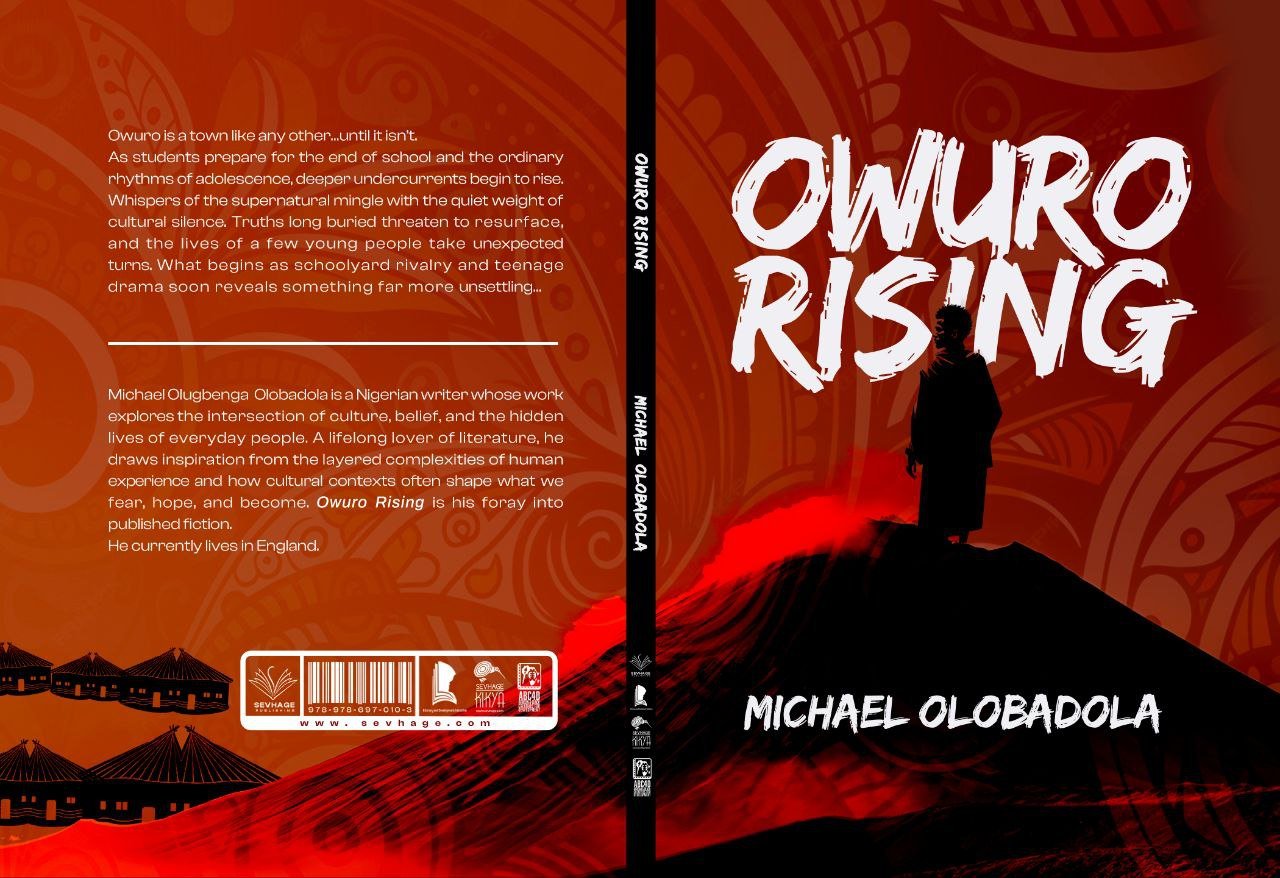
Michael Olugbenga Olobadola’s Owuro Rising is a novel that gestures towards poetry, not in the conventional sense of form or metre, but in the texture of its language, the way it listens to voice, silence, and affect. The book is the first volume of a trilogy and does not rush to deliver a self-contained arc. It establishes a terrain in which characters, place, and emotion intertwine. Readers familiar with the meandering style of Ben Okri’s The Famished Road or the mythic lyricism of Akwaeke Emezi’s Freshwater will recognise a form of investment in the work that leans into the poetic.
Owuro Rising is set in a fictional town, Owuro in Ondo state, Nigeria. On the surface, the town looks ordinary with its schools and school assemblies, street chatter, teenage rivalries, church services, local government politics, everyday squabbles and the like. However, the reader gets to know from the beginning that it is also a town watched by spirits, interrupted by masquerades, and haunted by ancestral energies. In this world, the spiritual is not metaphorical but very present. Witches exist, sirens sing, and there is a shapeshifter, all pursued by a religious hunter in the mould of Van Helsing. Thus, the supernatural is woven into the reality of the novel’s world. In crafting such a setting, Olobadola follows the established traditions of writers like the canonically elderly Amos Tutuola and the more recent Nnedi Okorafor, who render African cosmology not as mystical otherness but as vital cultural framework. What distinguishes Owuro Rising, however, is its calmness most noticeable in its language which is mostly reflective, with repetitions at some points, and rhythm for effect.
This rhythm is central to the book’s style as the entire work is told in the first person and in the vocal cadence of the respective characters from whose viewpoint each of the seven chapters of the book are told. In the end, the narration builds, accumulates, and circle back. Emmanuel, the first narrator, carries a voice shaped by trauma but softened by longing. His memories are punctuated with philosophical asides, while one notices some form of meditation in his sentences. The next narrator, Lola, has a perspective that carries urgency and ache, filled with metaphor and emotional layering. Kenny’s voice, more measured, navigates both the weight of friendship and the awakening of spiritual knowledge. Another intriguing voice is that of Sadiat, the Vice Chair of Owuro town, who is feminist in her leanings and deeply passisonate about her town. Across all these perspectives, the language of the novel maintains a softness, even in moments of tension, as though to suggest that what matters is not how loud a story is told, but how deeply it listens.
Such an approach aligns Owuro Rising with a sensibility that seems to value tone, echo, and cultural depth. For instance, Owuro, though fictional, is textured with details that evoke a very Nigerian geography of feeling. The brown roofs, the markets, the school compound, the spiritual sites are seen not just as physical locations but as emotional landscapes. Like Koleka Putuma’s poetic explorations of place and inheritance in Collective Amnesia, Olobadola’s narrative posits the non-neutrality of setting which is shown to be alive, responsive, and complicit. An easy way to note this is how any episode in the novel taken away from the scene where it happens would lose value, originality, and relevance. One notices that a school scene would carry the energy and tension of such a place, such that the scene where Lola has a fight with her best friend and is humiliated could only have taken place in the hall. This also becomes the same case for other settings like the hospital where a detective gets miraculous healing and the school theatre hall where the climax of the novel takes place.
The characters themselves are not extraordinary in the typical fantasy sense that most readers would be familiar with. They are young, flawed, afraid, hopeful. Their “powers” or spiritual abilities do not render them distant or godlike. Instead, they must navigate these identities quietly, almost reluctantly. This human-scale rendering of the mythic is one of the novel’s quieter achievements. Rather than using the supernatural for spectacle except where absolutely necessary, Olobadola uses it to explore agency, silence, and consequence.
That is not to say the novel is without challenge. Readers seeking a tightly plotted narrative or a clearly structured magical system may find the pace to be unhurried and the cosmology loosely drawn. But these are not flaws in the traditional sense — they reflect a literary choice. This seems like a deliberate style where the author trusts the reader to walk the road of his imagined narrative without full maps.
Ultimately, Owuro Rising is a novel that makes a case for paying attention to tone, voice, and spirit. It is a novel that knows language does more than describe. It is a fine work of fiction that offers a space where poetry and story are not rivals but kin.